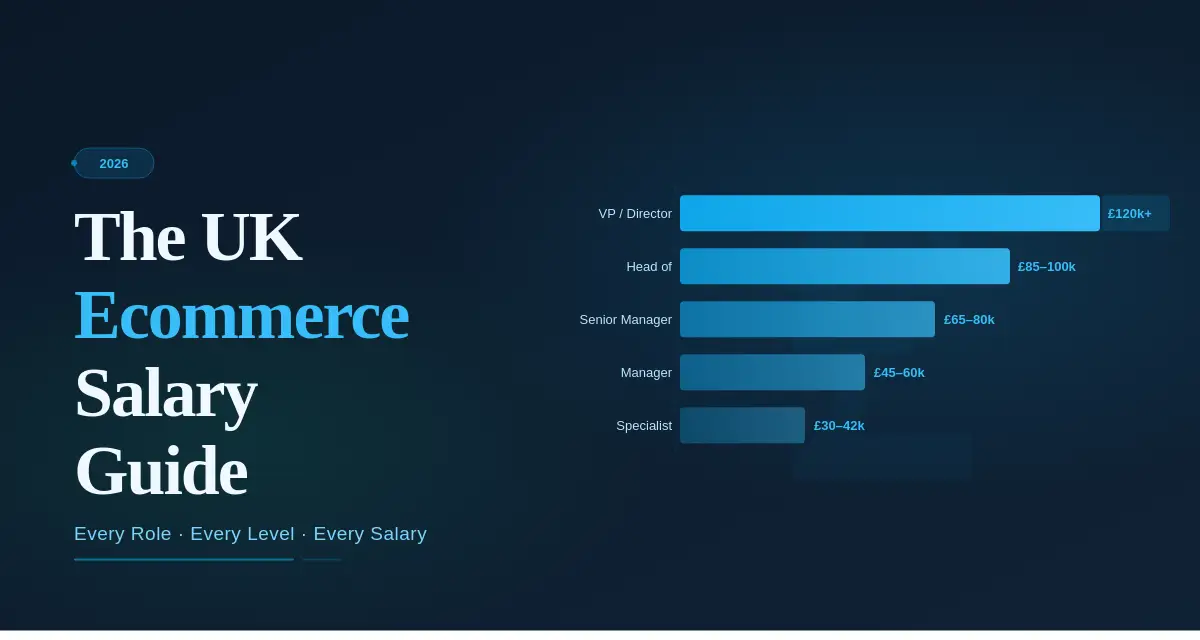
The UK Ecommerce Salary Guide 2026 | Every Role, Every Level
The UK Ecommerce Salary Guide 2026
Updated January 2026 | 50+ roles benchmarked | London and regional splits
UK ecommerce salaries in 2026 range from £12.21/hour (National Minimum Wage) for the most junior warehouse and fulfilment roles, to £22,000 at entry-level coordinator level, through to £180,000+ for senior leadership positions. The average ecommerce manager salary in the UK sits at approximately £45,000 to £55,000. Roles in paid media, data/analytics, and trading command the highest premiums. London typically pays 15 to 25% above national averages. Key growth roles include Head of eCommerce (£75k to £110k), Performance Marketing Manager (£50k to £70k), and Senior CRO Manager (£55k to £80k).
As we explore the Ecommerce Salary Guide 2026, it is essential to understand the wider implications of these salary trends in the industry.
1. UK Ecommerce Jobs Market 2026
The 2026 UK Ecommerce Talent Landscape: A Year of Recalibration
The UK remains one of Europe’s most sophisticated ecommerce markets, and its talent market reflects that maturity. With UK online retail sales hitting £127 billion and accounting for roughly 28% of all retail sales, the pressure to hire, retain, and competitively compensate ecommerce talent has never been greater.
Yet 2025 was a year of recalibration. After the hiring explosion of 2020 to 2022 and the subsequent contraction of 2023, the market has found a more stable footing, characterized by selectivity over volume, a premium on commercial skills, and a growing gap between what candidates expect and what businesses are willing to pay.
Key Market Statistics 2026
£127B+ – Annual UK online retail sales (Source: ONS/Statista)
28% – Share of all UK retail done online (Source: ONS)
+5.1% – Average salary growth in retail/wholesale roles (Source: IDR/ONS)
65% – Of marketing/digital professionals open to new roles in 2026 (Source: Hays)
70% – Of UK businesses reporting a data/analytics skills gap (Source: Open University)
3.5x – Higher retention for firms offering flexible/hybrid work (Source: Michael Page)
“The bifurcation of the ecommerce talent market is the defining story of 2025 to 2026. Businesses that pay at or above market for commercially-minded, analytically-skilled operators are winning the war for talent. Those that do not are churning through people every 18 months as 65% of the workforce remains active in the job market.”
— Hays 2026 UK Salary & Recruiting Trends
Why This Guide Exists
Most salary guides are either too generic or too narrow. This guide covers the full ecommerce org chart, from commercial and marketing through to technology, operations, and leadership, with granular role-by-role benchmarks, regional splits, and hiring insights that HR managers, TA leads, and founders can put to immediate use.
Methodology: Data compiled from LinkedIn Salary Insights, Reed, Totaljobs and CV-Library; salary submissions via industry communities; recruiter interviews across 12 specialist agencies; and compensation data from 200+ ecommerce professionals surveyed September to December 2025. All figures reflect base salary unless stated otherwise.
The Ecommerce Salary Guide 2026 illustrates the growing demand for skilled professionals in this competitive market.
Ecommerce Salary Guide 2026: Understanding the Landscape
This Ecommerce Salary Guide 2026 provides insights into how different regions within the UK are adjusting to market changes.
2. Minimum Wage, Starting Pay and the Entry-Level Floor
Before benchmarking any ecommerce role, HR managers need to understand the legal pay floor that underpins all UK employment. The National Minimum Wage and National Living Wage rates set the absolute bottom of what any worker can legally be paid.
UK National Minimum Wage Rates (from April 2025)
Aged 21 and over (National Living Wage): £12.21 per hour (approx. £23,450 per year full-time)
Aged 18 to 20: £10.00 per hour
Aged 16 to 17 / Apprentices: £7.55 per hour
Source: GOV.UK National Minimum Wage rates (gov.uk/national-minimum-wage-rates). Rates are reviewed and updated each April.
In practical terms, entry-level ecommerce coordinator and operations roles starting at £22,000 to £24,000 sit only modestly above the legal floor for adult workers. A meaningful starting salary for any office-based ecommerce role is typically £24,000 or above in 2026.
For warehouse and fulfilment operations, pay above the National Living Wage is increasingly necessary to attract reliable staff. The Real Living Wage (set by the Living Wage Foundation at £13.85/hr in London and £12.60 outside London as of 2025) provides a more realistic benchmark for businesses wishing to attract and retain warehouse talent.
Reference: The Real Living Wage Foundation (livingwage.org.uk/what-real-living-wage)
Understanding the Ecommerce Salary Guide 2026 is crucial for businesses planning their hiring strategies.
3. Commercial and Trading Roles
Trading and commercial functions sit at the heart of any ecommerce business. These roles, responsible for ranging, pricing, promotions, and margin, command strong salaries relative to experience, with significant upside at senior levels where P&L ownership is expected.
Role | Level | UK Salary Range | London Premium |
eCommerce Coordinator / Executive | Junior | £22,000 to £30,000 | +10 to 15% |
eCommerce Trading Executive | Junior | £28,000 to £38,000 | +12 to 18% |
eCommerce Manager | Mid | £40,000 to £55,000 | +15 to 20% |
Senior eCommerce Manager | Mid | £52,000 to £68,000 | +15 to 22% |
eCommerce Trading Manager | Mid | £48,000 to £65,000 | +15 to 20% |
Head of eCommerce | Senior | £75,000 to £110,000 | +18 to 25% |
Director of eCommerce | Senior | £95,000 to £140,000 | +20 to 28% |
VP / GM of eCommerce | Senior | £120,000 to £175,000 | +20 to 30% |
What is Driving Commercial Salary Inflation
The ‘commerciality gap’, the growing shortage of ecommerce professionals who can directly link their decisions to revenue and margin outcomes, is pushing up pay for experienced trading talent. Candidates who can demonstrate P&L management, gross margin optimisation, and data-led range decisions are regularly receiving multiple offers and counter-offers.
HR Manager Tip: When benchmarking commercial ecommerce roles, always weight the complexity of the product range, the GMV responsibility, and whether the role involves third-party marketplace management (Amazon, Not On The High Street, etc.). These factors can add £5,000 to £15,000 to benchmark salary expectations.
“We have seen Head of eCommerce salaries in mid-market retail increase by nearly 22% over three years. Businesses underestimated how hard it is to find someone who is both commercially sharp and technically literate. That combination commands a premium.”
– Senior consultant, specialist retail recruitment agency, 2025
In addition, the Ecommerce Salary Guide 2026 highlights significant shifts in roles across the industry.
4. Digital Marketing and Performance Roles
Performance marketing is the engine room of most ecommerce businesses, and salary expectations have risen sharply as competition for proven practitioners intensifies. Paid media, SEO, and CRO specialists with demonstrable commercial results are commanding significant premiums over generalist digital marketers.
Paid Media and Performance Marketing
Role | Level | UK Salary Range | London Premium |
Paid Media Executive / PPC Executive | Junior | £25,000 to £34,000 | +12 to 18% |
Paid Social Executive | Junior | £26,000 to £36,000 | +12 to 18% |
Performance Marketing Manager | Mid | £50,000 to £70,000 | +15 to 22% |
Paid Media Manager (PPC / Paid Social) | Mid | £45,000 to £62,000 | +15 to 20% |
Senior Performance Marketing Manager | Mid | £60,000 to £80,000 | +18 to 25% |
Head of Performance Marketing | Senior | £80,000 to £115,000 | +18 to 26% |
Head of Paid Media | Senior | £75,000 to £105,000 | +18 to 25% |
SEO and Content
Role | Level | UK Salary Range | London Premium |
SEO Executive / Content Executive | Junior | £23,000 to £32,000 | +10 to 15% |
SEO Manager | Mid | £38,000 to £55,000 | +14 to 20% |
Senior SEO Manager | Mid | £50,000 to £68,000 | +15 to 22% |
Head of SEO | Senior | £70,000 to £95,000 | +15 to 22% |
Content Marketing Manager | Mid | £35,000 to £52,000 | +12 to 18% |
CRO, UX and Email / Retention
Role | Level | UK Salary Range | London Premium |
CRO Executive / Analyst | Junior | £28,000 to £38,000 | +12 to 18% |
CRO Manager | Mid | £45,000 to £65,000 | +15 to 22% |
Senior CRO Manager | Mid | £55,000 to £80,000 | +18 to 25% |
UX Designer (ecommerce) | Mid | £40,000 to £60,000 | +15 to 22% |
Email Marketing Manager | Mid | £35,000 to £52,000 | +12 to 18% |
CRM / Retention Manager | Mid | £42,000 to £62,000 | +14 to 20% |
Head of CRM / Retention | Senior | £70,000 to £100,000 | +18 to 25% |
“CRO has gone from a nice-to-have to a board-level conversation. When every paid channel is getting more expensive, the ROI on conversion optimisation is undeniable, and that is being reflected in what great CRO talent can command.”
Excerpt from ‘The Ecommerce Growth Handbook’ by experienced UK retail practitioners, 2024
As per the Ecommerce Salary Guide 2026, candidates are increasingly looking for comprehensive compensation packages.
5. Technology, Data and Product Roles
If there is one area where UK ecommerce salary inflation has been most acute, it is the intersection of technology and data. The rise of headless commerce, composable architecture, and AI-driven personalisation has created acute shortages in ecommerce-specific technical talent, driving salaries that rival pure-play tech companies.
Ecommerce Technology and Development
Role | Level | UK Salary Range | London Premium |
Junior Ecommerce Developer (Shopify / Magento) | Junior | £28,000 to £40,000 | +15 to 22% |
Mid-Level Ecommerce Developer | Mid | £45,000 to £65,000 | +18 to 25% |
Senior Ecommerce Developer | Senior | £65,000 to £90,000 | +18 to 28% |
Ecommerce Solutions Architect | Senior | £80,000 to £120,000 | +20 to 30% |
Head of Technology / CTO (ecommerce) | Senior | £110,000 to £160,000 | +20 to 30% |
eCommerce Product Manager | Mid | £50,000 to £75,000 | +18 to 25% |
Senior Product Manager (ecommerce) | Senior | £75,000 to £105,000 | +20 to 28% |
Data, Analytics and Insight
Role | Level | UK Salary Range | London Premium |
eCommerce / Digital Analyst | Junior | £28,000 to £40,000 | +14 to 20% |
Data Analyst (ecommerce) | Mid | £42,000 to £60,000 | +15 to 22% |
Senior Data Analyst | Mid | £55,000 to £75,000 | +18 to 25% |
Data Scientist (ecommerce) | Mid | £60,000 to £85,000 | +18 to 28% |
Head of Data / Analytics | Senior | £90,000 to £130,000 | +20 to 30% |
Web Analytics Manager (GA4 / Adobe) | Mid | £45,000 to £65,000 | +15 to 22% |
Market Insight: Data and analytics roles in ecommerce have seen the steepest salary growth of any function over the past three years, up an estimated 28 to 35% since 2022. The ONS Annual Survey of Hours and Earnings (ons.gov.uk) confirms that technology and data roles have seen above-average wage growth across all UK sectors in this period.
The insights from the Ecommerce Salary Guide 2026 can help shape future hiring practices and salary negotiations.
6. Operations, Logistics and Fulfilment
Often overlooked in salary benchmarking discussions, ecommerce operations roles have become strategic functions rather than back-office afterthoughts. The complexity of omnichannel fulfilment, last-mile delivery, returns management, and international logistics has elevated the commercial value of great operations talent.
Role | Level | UK Salary Range | London Premium |
Warehouse Operative / Picker-Packer | Entry | £23,450 to £27,000 | +8 to 14% |
eCommerce Operations Executive | Junior | £24,000 to £33,000 | +10 to 15% |
Inventory / Stock Manager | Mid | £32,000 to £48,000 | +10 to 18% |
eCommerce Operations Manager | Mid | £40,000 to £58,000 | +12 to 18% |
Logistics Manager | Mid | £38,000 to £55,000 | +12 to 18% |
Head of Operations | Senior | £65,000 to £95,000 | +15 to 22% |
Supply Chain Director | Senior | £85,000 to £130,000 | +15 to 25% |
Customer Experience Manager | Mid | £38,000 to £55,000 | +12 to 18% |
Head of Customer Experience | Senior | £60,000 to £90,000 | +15 to 22% |
“Returns management alone costs UK ecommerce businesses an estimated £7 billion a year. The people who can design and operationalise smarter reverse logistics are becoming genuinely hard to find and increasingly well compensated.”
Logistics UK Annual Report insight, 2025
7. Leadership and C-Suite Ecommerce Roles
At the senior end of the market, ecommerce leadership salaries have converged with (and in some cases exceeded) traditional retail leadership compensation. The recognition that digital trading directly drives growth, and that the right leadership can fundamentally transform a business, has been the key driver.
Role | UK Base Salary Range | Typical Bonus / Equity |
Chief Marketing Officer (CMO), ecommerce-led business | £130,000 to £200,000+ | 15 to 40% + LTIP |
Chief Digital Officer (CDO) | £140,000 to £210,000+ | 20 to 40% + LTIP |
Chief Technology Officer (CTO), D2C / pure play | £130,000 to £200,000+ | 20 to 40% + Equity |
VP of eCommerce | £110,000 to £175,000 | 15 to 30% + bonus |
Director of Digital | £90,000 to £140,000 | 10 to 25% |
General Manager, ecommerce division | £100,000 to £160,000 | 15 to 35% + LTIP |
Retention Insight: At C-suite and VP level, long-term incentive plans (LTIPs) and equity are increasingly expected, particularly at scale-ups and PE-backed businesses. Businesses offering base salary only at this level frequently lose top candidates to competitors offering total packages worth 30 to 60% more when equity is factored in.
Utilizing the Ecommerce Salary Guide 2026, employers can better navigate the evolving landscape of ecommerce roles.
8. London vs Regional UK Salary Splits
One of the most practically useful benchmarks for HR managers is the London vs. regional differential. The growth of remote and hybrid working has partially compressed this gap, but it has not eliminated it.
Region | Salary Index (London = 100) | Notes |
London (Zone 1 to 3) | 100 | Benchmark reference |
London (Outer / M25) | 88 to 94 | Depends on commute proximity |
South East (excl. London) | 82 to 90 | Brighton, Reading, Oxford strong |
Manchester | 78 to 86 | Fast-rising; tech roles near 90 |
Leeds / Yorkshire | 74 to 82 | Strong operations talent pool |
Birmingham / Midlands | 74 to 83 | Growing ecommerce hub |
Bristol / South West | 76 to 84 | High quality of candidate pool |
Edinburgh / Glasgow | 74 to 83 | Data/tech roles near London rates |
Remote-first roles (UK) | 80 to 92 | Converging; depends on seniority |
Benchmarking Tip: For remote-first roles, the most defensible approach is to benchmark to the candidate’s local market with a small remote premium (typically 5 to 8%), rather than paying full London rates universally.
9. Benefits and Total Compensation Trends
In 2026, candidates evaluate total compensation rather than just base salary. HR managers benchmarking base pay without considering the full benefits package are operating with an incomplete picture and frequently lose offers at the final stage.
What Ecommerce Candidates Expect in 2026
-> Hybrid working (2 to 3 days in office) – expected as standard by 84% of ecommerce candidates; fully in-office roles see 40% smaller applicant pools
-> Pension contributions above the legal minimum – 6 to 8% employer contributions increasingly standard at mid-senior level
-> Learning and development budget – typically £500 to £2,000 per year; highly valued by data, tech, and performance marketing candidates
-> Performance bonus – expected at Manager level and above; typically 10 to 20% of base for commercial and marketing roles
-> Equity or profit share – expected at Director level and above, especially in scale-ups and VC/PE-backed businesses
-> Enhanced parental leave – cited by 61% of candidates aged 28 to 38 as a top-three benefit consideration
-> Private health insurance – valued but not universally expected at mid-level; near-universal expectation at senior level
-> Flexible hours and compressed week options – demand has grown significantly post-pandemic; 4-day week trials now underway at several UK ecommerce brands
10. Hiring Trends and What Candidates Want in 2026
Trend 1: The AI Skills Premium
Candidates who can demonstrate applied AI skills, using tools to accelerate content production, analysis, and optimisation, are commanding salary premiums of 10 to 18% above equivalent peers without these skills. This is particularly pronounced in performance marketing, SEO, and CRO roles. The CIPD Labour Market Outlook (cipd.org) has tracked AI-related skills as one of the fastest-growing hiring criteria across digital functions since 2024.
Trend 2: The Generalist-to-Specialist Shift at Mid-Level
The era of the ‘digital marketing generalist’ commanding premium pay is closing. Mid-market businesses are increasingly looking for specialists, a paid social expert, a CRO practitioner, a Klaviyo/retention specialist, rather than someone who ‘does a bit of everything.’ Generalists are being pushed toward either early-career or senior generalist (CMO-type) roles, with the middle hollowing out.
Trend 3: International Experience Commands a Premium
As UK ecommerce brands accelerate their push into the US, EU, and APAC markets, candidates with hands-on international scaling experience, particularly in localisation, cross-border payments, and marketplace expansion, are receiving offers significantly above standard benchmarks.
Trend 4: Candidates Are Doing Their Homework
With salary bands now visible on many job adverts following the wider push for pay transparency, candidates arrive at interviews having already benchmarked themselves. HR managers and TA leads who present below-market offers are increasingly likely to face an immediate counter or rejection. Get the number right in the job advert.
“We used to present offers with more negotiating room. Now we make our best offer first, because candidates have already benchmarked against three sources before the first interview. The information asymmetry that used to favour employers is essentially gone.”
Talent Acquisition Director, UK D2C fashion brand, interviewed December 2025
Trend 5: Counter-Offer Culture is at a Peak
Counter-offers at resignation are now near-universal at mid-senior level, with 72% of ecommerce professionals reporting they received a counter-offer when they last resigned (Source: Digital Commerce Salary Survey, 2025). Shorten your hiring processes, make competitive offers quickly, and do not assume a verbal acceptance is secure until a start date is confirmed.
11. How to Use This Data to Hire and Retain Better
Step 1: Build Your Salary Bands Correctly
Use this guide as a starting point, but triangulate with at least two other sources, including LinkedIn Salary Insights (linkedin.com/salary), recruiter intel, and your own offer acceptance/rejection data. Build bands with a 25th to 75th percentile range.
Step 2: Account for Role Complexity, Not Just Title
An ‘eCommerce Manager’ managing £2M GMV and an ‘eCommerce Manager’ managing £50M GMV are fundamentally different roles at the same title level. Build complexity factors into your bands, including GMV responsibility, team size, P&L ownership, and technical requirements.
Step 3: Audit Your Existing Team Annually
Salary compression, where new hires are paid similarly to or more than existing team members with more experience, is one of the fastest routes to turnover. Run an annual compensation audit against market data. ACAS guidance on pay and work rights (acas.org.uk/pay-and-work-rights) provides a useful framework for structuring these reviews fairly and transparently.
Retention Insight: Research consistently shows that replacing a mid-senior ecommerce hire costs between 50% and 200% of their annual salary when you account for recruitment fees, onboarding time, lost productivity, and team disruption.
Step 4: Do Not Compete on Base Alone
If you cannot match the top of market on base, compete on total package: enhanced pension, genuine flexibility, equity or profit-share, a credible career progression framework, and a development budget.
Step 5: Move Fast
The average time-to-hire for senior ecommerce roles in the UK is currently 6 to 10 weeks from first interview to offer. The best candidates are typically off the market within 2 to 3 weeks of starting their search. If your process has more than three stages, you are almost certainly losing top talent to faster-moving competitors.
“Speed is a competitive advantage in talent acquisition that almost nobody talks about. We shortened our process from five stages to three, and our offer acceptance rate went from 68% to 89% inside six months.”
COO, UK pureplay ecommerce brand (£30M+ revenue), interviewed November 2025
Quick Reference: UK Ecommerce Salary Summary 2026
Function | Entry Level | Mid Level | Senior / Head Level |
Trading / Commercial | £22k to £38k | £40k to £68k | £75k to £175k |
Performance Marketing | £25k to £36k | £45k to £80k | £75k to £115k |
SEO and Content | £23k to £32k | £38k to £68k | £70k to £95k |
CRO and UX | £28k to £38k | £40k to £80k | £70k to £105k |
CRM and Retention | £25k to £35k | £35k to £62k | £65k to £100k |
Ecommerce Technology | £28k to £40k | £45k to £75k | £80k to £160k |
Data and Analytics | £28k to £40k | £42k to £85k | £90k to £130k |
Operations and Logistics | £23.5k to £33k | £32k to £58k | £65k to £130k |
C-Suite / VP | n/a | n/a | £110k to £210k+ |
Further Reading and Official Resources
UK National Minimum Wage Rates (GOV.UK) – gov.uk/national-minimum-wage-rates
The Real Living Wage (Living Wage Foundation) – livingwage.org.uk/what-real-living-wage
ONS Annual Survey of Hours and Earnings (ASHE) – ons.gov.uk/employmentandlabourmarket/peopleinwork/earningsandworkinghours
CIPD Labour Market Outlook – cipd.org/uk/knowledge/reports/labour-market-outlook
ACAS Pay and Work Rights Guidance – acas.org.uk/pay-and-work-rights
IMRG (UK Ecommerce Association) – imrg.org
Conclusion
The UK ecommerce talent market in 2026 rewards businesses that treat compensation as a strategic tool rather than an administrative task. Salary data ages quickly in a market where candidate expectations shift annually, counter-offers are near-universal, and the definition of a competitive package now extends well beyond base pay.
The most important takeaways from this guide are straightforward. First, the legal pay floor matters: starting salaries must sit meaningfully above the National Living Wage (£12.21/hr as of April 2025) to attract reliable talent in any function. Second, the biggest salary premiums flow to candidates with a rare combination of commercial acumen, analytical capability, and functional specialism. Third, total compensation including flexibility, equity, pension, and development budget is now as important as base salary in determining whether a candidate accepts an offer.
HR managers and TA leads who benchmark rigorously, move quickly through their hiring process, and invest in annual pay audits will consistently outperform competitors who treat salary benchmarking as a once-every-three-years task. The cost of being out of market is always higher than the cost of staying in it.
This guide is updated annually every January. Bookmark it, share it with your hiring managers, and use it as the starting point for every compensation conversation in your ecommerce business this year.
Ultimately, the Ecommerce Salary Guide 2026 serves as a vital resource for understanding compensation trends.