
How to Become a Head of eCommerce | Essential 6-Step Path
Career Path
How to Become a Head of eCommerce | Essential 6-Step Path
The career path, the skills to build, and how to make the leap
Learning how to become a Head of eCommerce is about a deliberate build over years. It is one of the most senior roles in an online business, owning the digital P&L, the trading strategy and the team that delivers online revenue, so employers hire on proof, not potential. Most people reach it after five to ten years, moving from an executive or manager role into senior leadership as they show they can grow revenue, run a budget and lead a team. There is no single route, but there is a clear pattern: broaden your commercial skills, own bigger numbers, and build the leadership that a board will trust.
This guide maps how to become a Head of eCommerce step by step: what the role really involves, the typical career path, the skills and experience you need, and the practical moves that get you there. Read the detail below, then talk to us about your next step.
5-10 yrs
Typical route to the role
Typical route to the role
£75k+
Head of eCommerce base pay
Head of eCommerce base pay
P&L
Ownership is the dividing line
Ownership is the dividing line
6
Steps to get there
Steps to get there
Quick Answer
To learn how to become a Head of eCommerce, build a track record of growing online revenue, take on P&L and budget responsibility, and lead a cross-functional team. Most people get there in five to ten years by moving from eCommerce Executive to Manager to Senior Manager, then into the Head of role.
The skills that decide how to become a Head of eCommerce are commercial ownership, digital marketing and trading fluency, data and analytics, and leadership. Widen your experience across the online business, own bigger numbers each step, and make your results easy to see.
Section 01
What the Role Really Involves
Before you work out how to become a Head of eCommerce, it helps to be clear on what the job actually is. A Head of eCommerce owns the online channel end to end: the trading strategy, the digital P&L, the website and its performance, the marketing that drives traffic, and the team that runs it all. They sit between the board and the specialists, translating commercial goals into a plan and reporting on the numbers.
The dividing line from a manager role is ownership. A Head of eCommerce is accountable for revenue and profit, sets the budget, and answers for the result. For the full duties, see our Head of eCommerce job description, and for pay by business type, our Head of eCommerce salary guide.
Section 02 · The Ladder
The Typical Career Path
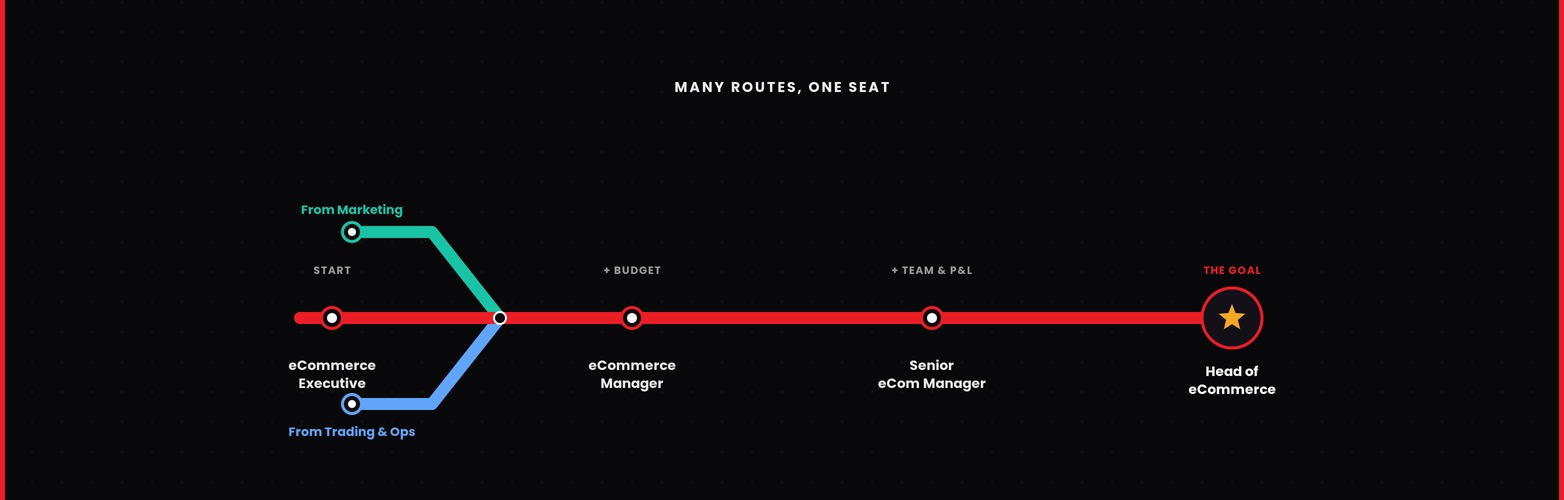
No two careers look identical, but how to become a Head of eCommerce follows a recognisable ladder. Each rung adds scope, bigger numbers and more people, and the pay climbs with the responsibility. Here is the common path, with typical UK pay and how long people tend to spend on each rung.
01
eCommerce Executive / Coordinator
£24k–32k · 1–2 yrs
Learn the platform, merchandising, content and reporting. Build the fundamentals across the online store.
02
eCommerce Manager
£40k–55k · 2–4 yrs
Own trading and the day-to-day of the site, start managing budget and, often, a first report. Deliver growth.
03
Senior eCommerce Manager
£55k–75k · 2–4 yrs
Lead a small team, own a channel P&L, and shape strategy. This is the launch pad for the Head of role.
04
Head of eCommerce
£75k–110k+ · the goal
Own the whole online channel, the P&L and the team, and report to the board. The next step is Director or C-suite.
Pay is indicative UK base salary for 2026; London and larger brands pay more, and enterprise Heads of eCommerce reach £120k to £150k. Some people arrive from marketing, trading or agency backgrounds rather than a straight line, which is fine. Scope and results matter well beyond the exact job titles behind you.
Section 03 · Skills
Skills and Experience You Need
A big part of how to become a Head of eCommerce is building the right mix of skills. The role is a blend of commercial, marketing, technical and leadership skill. You do not need to be the deepest expert in any single area, but you do need enough range to lead the specialists and enough commercial judgement to own the number. These are the areas hiring boards test hardest.
💰 Commercial and P&L ownership
The single biggest step up. Show you can set and hit revenue and margin targets, build a budget, and make trade-offs that protect profit.
📱 Digital marketing and trading fluency
Enough depth across SEO, paid media, CRM, merchandising and conversion to direct the mix and challenge the specialists intelligently.
📊 Data and analytics
Comfort with GA4, dashboards and the metrics that matter, so you can spot what is working, act on it, and report it to the board.
🧩 Platform and tech awareness
You do not need to code, but you must understand Shopify, Magento or a headless stack well enough to own a roadmap and brief developers.
👥 Leadership and stakeholder management
Hiring, developing and directing a team, plus the influence to align marketing, buying, ops and the board behind one plan.
Section 04
How to Become a Head of eCommerce in 6 Steps
1
Master the fundamentals first
Get genuinely good at the day-to-day: platform, merchandising, content, analytics and campaigns. A Head who once did the work leads the team far better.
2
Broaden beyond your specialism
If you come from marketing, learn trading and merchandising; if from operations, learn acquisition. A Head needs range across the whole online business, so volunteer for the areas you know least.
3
Take ownership of a number
Ask to own a revenue line, a channel P&L or a budget. Being accountable for a result, not merely a task, is the clearest signal that you are ready to lead.
4
Start leading people
Line-manage a report, mentor a junior, or lead a cross-functional project. Evidence that you can hire, develop and get results through others is what the Head step demands.
5
Make your results visible
Keep a running record of the growth you drove, the projects you led and the money you made or saved. A Head of eCommerce is hired on a story of results, so make yours easy to tell.
6
Time the move and get backed
Sometimes the Head role is a promotion in place; often it means moving to a business where the seat is open. A specialist recruiter knows which brands are hiring at this level and can position you for it. Talk to our team when you are ready.
Section 05
Pay and What to Expect
Pay is a fair question when you are planning how to become a Head of eCommerce. A Head of eCommerce in the UK typically earns £75,000 to £110,000 base, rising to £120,000 to £150,000 at larger brands or with a bigger P&L, and higher again in London, as Glassdoor benchmarks confirm. Most packages add a bonus tied to revenue or profit, and some include equity at high-growth or founder-led businesses. Pay tracks the size of the channel you run: a £5m online business pays less than a £50m one, because the responsibility is different.
For a full breakdown by business type and how to benchmark an offer, see our Head of eCommerce salary guide. If you are hiring rather than climbing, our executive search team places leaders at this level, and the UK eCommerce Salary Guide maps every role below it.

Plan the Path, Own the Result
Knowing how to become a Head of eCommerce is really about a deliberate build: master the fundamentals, widen your range across the online business, take ownership of a number, and lead people while your results speak for themselves. Do that, and the title follows. When you are ready to plan the move, talk to our team or read our Head of eCommerce salary guide to benchmark where you stand.
FAQ
Frequently Asked Questions
01How long does it take to become a Head of eCommerce?
Most people reach Head of eCommerce five to ten years into their career, moving from executive to manager to senior manager before the step up. It can be faster in a small or high-growth business where you take on P&L ownership early, and slower in a large organisation with more rungs. Scope and results matter well beyond years served.
02What qualifications do you need to become a Head of eCommerce?
There is no required qualification. A degree in marketing, business or a related field helps, and course certificates in analytics or paid media can support you early on, but employers hire on track record. A clear story of growing online revenue, owning a budget and leading people counts far ahead of any certificate.
03What is the difference between an eCommerce Manager and a Head of eCommerce?
The main difference is ownership and scope. An eCommerce Manager runs the day-to-day trading and site, often within a set plan and budget. A Head of eCommerce owns the strategy and the P&L, sets the budget, leads the team, and answers to the board for the result. The Head role is a leadership job first and a hands-on one second.
04Can you become a Head of eCommerce from a marketing background?
Yes, and many do. There is no single way to become a Head of eCommerce: marketing, trading, merchandising and even operations are all common routes in. The key is to broaden out of your specialism and pick up the areas you know least, especially commercial and P&L ownership, so you can lead the whole online channel rather than one part of it.
05How much does a Head of eCommerce earn in the UK?
Pay is a fair question when you are planning how to become a Head of eCommerce. A Head of eCommerce in the UK typically earns £75,000 to £110,000 base, rising to £120,000 to £150,000 at larger brands or with a bigger P&L, and higher in London. Most packages add a bonus tied to revenue or profit, and some include equity. Pay tracks the size of the channel you run. See our Head of eCommerce salary guide for the full breakdown.
06What comes after Head of eCommerce?
The usual next steps are eCommerce Director, Digital Director or Chief Digital Officer, and at some businesses Managing Director of the online arm. These roles widen your remit across strategy, technology and sometimes the wider business, and lift pay into six figures well beyond the Head level. Broad commercial leadership is what opens them.
Sources and Further Reading
- Elite X Recruit: Head of eCommerce Salary UK
- Glassdoor: Head of eCommerce Salaries, UK (2026)
- Prospects: eCommerce Manager Career Profile
- Elite X Recruit: Head of eCommerce Job Description
- Elite X Recruit: UK eCommerce Salary Guide
- Elite X Recruit: eCommerce Executive Search
By the Elite X Recruit team, UK eCommerce and digital recruitment specialists. REC members. Salary figures are indicative 2026 benchmarks and vary by business size, sector and location.
Stay ahead of the eCommerce talent market
UK eCommerce and digital hiring guides, salary data, and career intelligence from our specialist team.