
Retained vs Contingency Recruitment | 5 Clear Differences
For Employers
Retained vs Contingency Recruitment | 5 Clear Differences
Which model suits your eCommerce hiring?
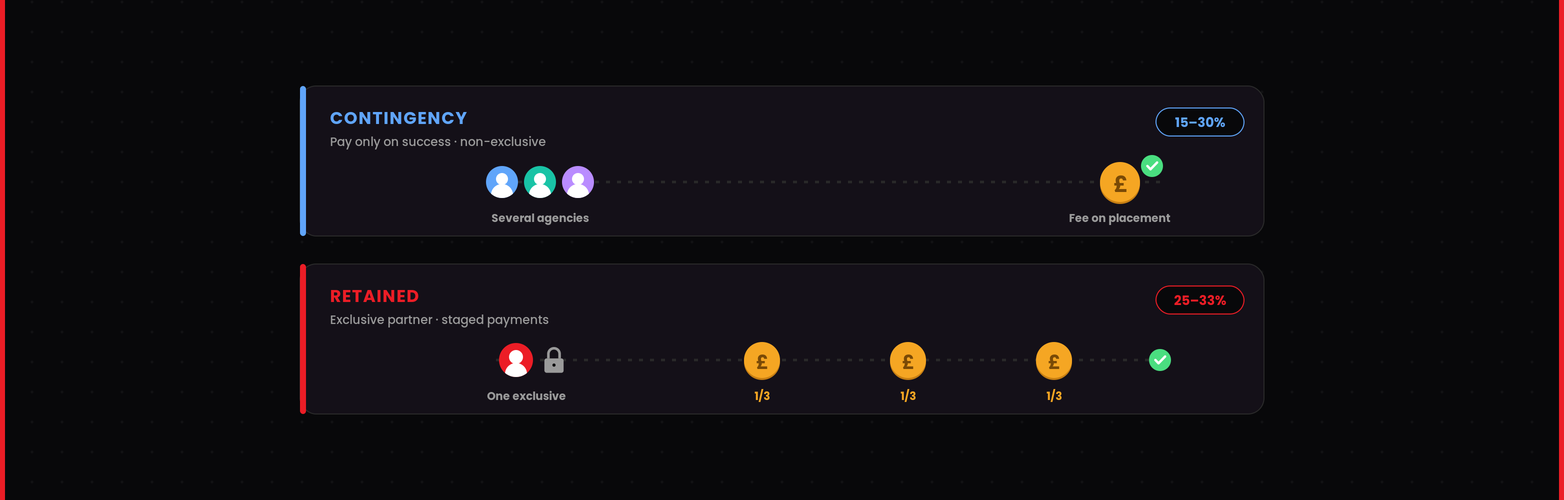
The retained vs contingency recruitment choice comes down to commitment and fit for the role. Contingency means you only pay a fee, usually 15 to 30 per cent of salary, when the agency successfully places someone, with no exclusivity and no upfront cost, which suits standard and mid-level roles where several routes to market can run at once. Retained search is an exclusive, committed partnership: you pay in stages, often in thirds, for a dedicated, thorough search, and it is the model of choice for senior, specialist, confidential or business-critical hires where getting the right person matters more than casting a wide net. Neither is better in the abstract, only better for a given role.
This guide compares the two models across five clear differences, shows which suits which eCommerce roles, and helps you choose. Read on, then book a call for a recommendation on your specific hire.
5
Differences, side by side
Differences, side by side
15-30%
Contingency fee of salary
Contingency fee of salary
25-33%
Retained search fee
Retained search fee
Senior
Where retained earns its place
Where retained earns its place
Quick Answer
On retained vs contingency recruitment: use contingency for standard and mid-level roles, where you pay only on a successful placement and can run several routes at once. Use retained search for senior, specialist, confidential or business-critical hires that demand an exclusive, dedicated search.
Contingency fees run 15 to 30 per cent of salary on placement; retained runs 25 to 33 per cent, paid in stages, in exchange for deeper commitment on both sides.
Section 01
What Each Model Means
Both are ways to work with a recruitment agency; the difference is how you engage and how you pay. Here is each model in plain terms.
Section 02 · Head to Head
Retained vs Contingency Recruitment: 5 Differences
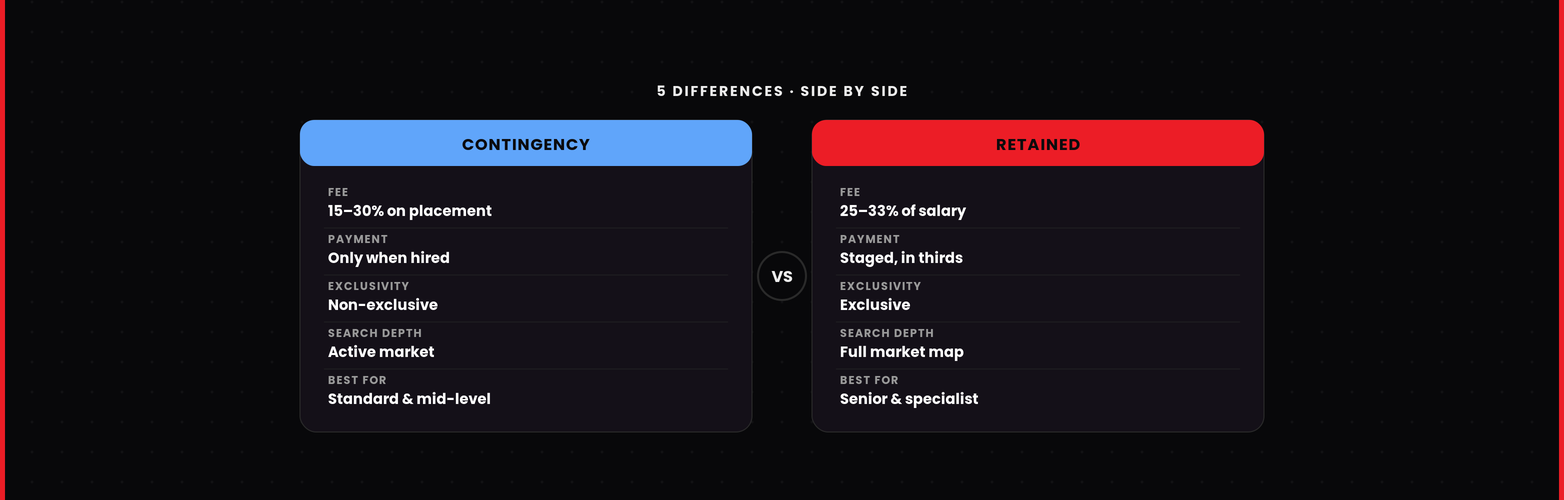
Here is the honest head-to-head on the five differences that decide which model fits.
| Difference | Contingency | Retained |
|---|---|---|
| Fee | 15-30% on placement | 25-33% of salary |
| Payment timing | Only when hired | Staged, often in thirds |
| Exclusivity | Non-exclusive | Exclusive commitment |
| Search depth | Active market | Full market map |
| Best for | Standard & mid-level | Senior & specialist |
Green marks the stronger fit on each factor. As the table shows, retained vs contingency recruitment is less about which is better and more about which matches the role in front of you.
Section 03
When Each Model Wins
Choose contingency when…
• The role is standard or mid-level.
• There is a healthy pool of candidates.
• You want to pay only on success.
• You are comfortable running several routes.
Choose retained when…
• The role is senior, niche or board-level.
• The hire is confidential or sensitive.
• You need the whole market mapped, not just applicants.
• Getting it right is business-critical.
In short, contingency wins on flexibility and low upfront risk for everyday roles; retained wins on rigour and certainty for the hires you cannot afford to get wrong. For those, our eCommerce executive search service runs a fully retained process.
Section 04
Which Suits eCommerce Hiring
In eCommerce, the right model usually tracks the seniority and scarcity of the role. Here is a simple map of what tends to suit each level.
For most everyday eCommerce roles, contingency is the pragmatic choice. As soon as a hire is senior, scarce, confidential or genuinely business-critical, the rigour of a retained executive search is worth the commitment. See how the whole picture fits together on our eCommerce recruitment agency hub.
Section 05
How to Choose Between Retained and Contingency
Deciding on retained vs contingency recruitment is quicker than it looks. Ask how senior and scarce the role is, how confidential it needs to be, and how costly a wrong or slow hire would be. The more you answer toward the top end, the more a retained search earns its commitment.
👤
Seniority — standard roles suit contingency; leadership suits retained.
🔍
Scarcity — the rarer the skill, the more a mapped, retained search pays off.
🔒
Confidentiality — sensitive or replacement hires point to a discreet retained search.
💰
Cost of getting it wrong — the higher the stakes, the more rigour is worth paying for.
Still unsure? We will tell you honestly which model fits your role. Compare the wider options in agency vs in-house, see what hiring really costs in our cost to hire breakdown, or benchmark pay with the UK eCommerce Salary Guide.
The Verdict
There is no universal winner in retained vs contingency recruitment, only the right model for the role. Use contingency for everyday eCommerce hires where you want to pay on success and keep your options open. Use a retained executive search for the senior, scarce or confidential roles where rigour and certainty matter most. Not sure which yours is? Our specialist team will give you a straight answer. Book a call or explore our eCommerce executive search service.
FAQ
Frequently Asked Questions
01What is the difference between retained and contingency recruitment?
Contingency recruitment means you pay a fee only when the agency places a candidate, with no exclusivity and no upfront cost. Retained search is an exclusive, committed engagement paid in stages, usually in thirds, in return for a dedicated, thorough search of the whole market. Contingency suits standard roles; retained suits senior and specialist hires.
02Is retained search worth the upfront cost?
For senior, scarce or confidential roles, usually yes. The staged fee buys an exclusive, mapped search that reaches passive leaders who never apply, plus a dedicated consultant and a rigorous process. For a business-critical hire where a mistake is costly, that certainty is worth the commitment. For everyday roles, contingency is the more pragmatic choice.
03What do retained and contingency recruitment cost?
Contingency fees typically run 15 to 20 per cent of first-year salary for standard roles and 20 to 30 per cent for senior or specialist ones, payable when the hire starts. Retained search is usually 25 to 33 per cent, paid in stages across the search. See our full cost to hire eCommerce talent breakdown for the wider picture.
04Which model is better for eCommerce roles?
It depends on the role. Most everyday eCommerce hires, developers, marketers, analysts and coordinators, are well served by contingency. Senior managers, scarce specialists and leadership or board roles such as Head of eCommerce or Head of Digital are better suited to a retained executive search, where a mapped, exclusive process finds the right person.
05Can you switch from contingency to retained?
Yes. Many employers start a role on contingency and move to a retained search if it proves hard to fill or turns out to be more senior or sensitive than first thought. A good recruiter will advise honestly on which model fits from the outset, and adjust if the brief changes.
06Is retained the same as executive search?
Executive search is almost always delivered on a retained basis, so the terms overlap. Retained describes the commercial model, exclusive and staged, while executive search describes the mapped, headhunting method used for senior and leadership roles. Our eCommerce executive search runs a fully retained process.
Sources and Further Reading
- REC: Recruitment & Employment Confederation
- AESC: Association of Executive Search and Leadership Consultants
- Elite X Recruit: eCommerce Executive Search
- Elite X Recruit: Cost to Hire eCommerce Talent
- Elite X Recruit: eCommerce Recruitment Agency Hub
By the Elite X Recruit team, a specialist UK eCommerce recruitment agency and REC member. Fee figures are indicative UK benchmarks for 2026 and vary by role and seniority.
Stay ahead of the eCommerce talent market
UK eCommerce and digital hiring guides, salary data, and market intelligence from our specialist team.